An objective comparison of CO2 and fiber laser platforms, the components that determine performance, and the material parameters you need to make an informed decision. No marketing fluff — just the engineering reality.
This is the most common question we receive. The answer depends entirely on your primary material. Here is a straightforward comparison based on physics and measured performance data from our application lab.
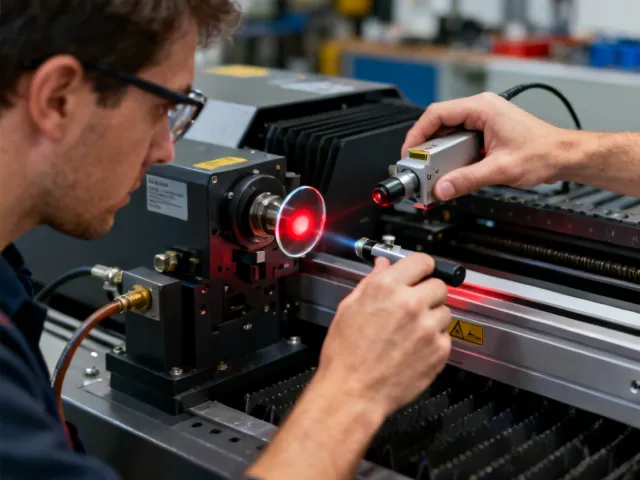
A CO2 laser generates infrared light at 10.6 micrometers wavelength by electrically exciting a gas mixture of CO2, nitrogen, and helium inside a sealed glass tube. The beam is directed to the workpiece through a series of mirrors and a focusing lens. At 10.6 um, organic materials (wood, acrylic, fabric, leather, paper) absorb the energy efficiently, causing clean vaporization along the cut path.
| Wavelength | 10.6 um (far infrared) |
| Power Range (Boss) | 40W - 260W |
| Laser Source | Reci glass tube |
| Source Life | 8,000 - 12,000 hours |
| Wall-Plug Efficiency | ~10-15% |
| Beam Delivery | Mirrors and focusing lens |
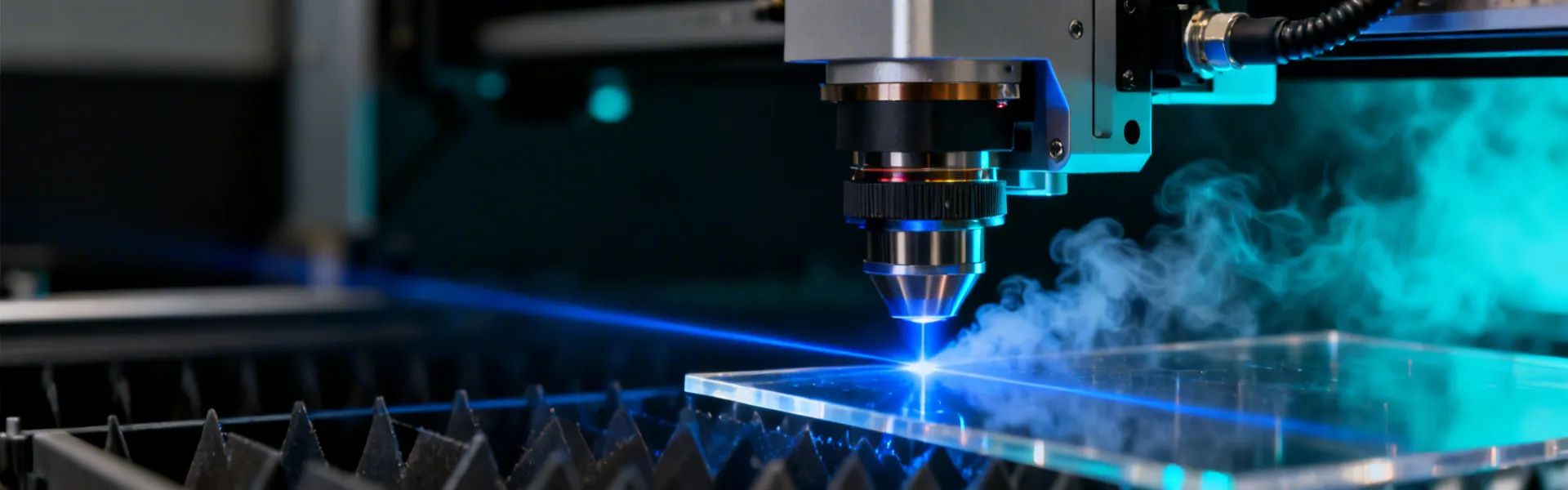
A fiber laser generates light at approximately 1.06 micrometers wavelength by pumping rare-earth doped optical fiber (typically ytterbium) with semiconductor diodes. The beam is delivered to the cutting head through a fiber optic cable — no mirrors to align. At 1.06 um, metals absorb the energy efficiently, enabling high-speed cutting of steel, aluminum, brass, and copper.
| Wavelength | 1.06 um (near infrared) |
| Power Range (Boss) | 1 kW - 6 kW |
| Laser Source | Raycus / IPG fiber module |
| Source Life | 100,000+ hours (rated) |
| Wall-Plug Efficiency | ~30-40% |
| Beam Delivery | Fiber optic cable (maintenance-free) |
Some customers operate both platforms — a CO2 for non-metal engraving and cutting, and a fiber for metal fabrication. Our application engineers can assess whether a single platform or dual setup best fits your product mix.
We disclose every critical component by brand and model. You can independently research each supplier and compare specifications against alternative machines. Transparency builds informed purchasing decisions.
CO2 systems use Reci glass laser tubes — the most widely deployed CO2 source in the <80W to 260W range. Fiber systems use Raycus (1-4kW) or IPG (4-6kW) modules. Each source is selected based on the power-to-reliability ratio for the target application. We stock replacement Reci tubes at our Florida facility for next-day domestic shipping.
Fiber platforms use Yaskawa industrial servo drives with absolute encoders for closed-loop position feedback. CO2 systems use stepper motors with optical encoders on belt-and-pinion drives. Both platforms ride on HIWIN preloaded linear guide rails with zero-backlash ball carriages. This combination delivers the +/-0.02mm positioning accuracy we specify.
Fiber laser cutting heads are sourced from Precitec (ProCutter) and Raytools (BT240S). Both feature autofocus with capacitive height sensing that maintains consistent standoff distance across warped or uneven sheet. CO2 systems use a precision 2-inch or 4-inch focus lens in a custom-machined aluminum head with integrated air assist nozzle.
CO2 systems use Ruida RDC6445 controllers — the industry standard for CO2 laser control, compatible with RDWorks and LightBurn software. Fiber systems use Cypcut controllers with integrated nesting software (CypNest), supporting DXF/DWG import and automatic nesting optimization for material yield maximization.
All Boss Laser frames are fabricated from welded carbon steel. Fiber platforms undergo thermal stress relief to eliminate residual welding stresses that could cause long-term dimensional drift. This process adds 3-4 days to production but ensures positional accuracy is maintained across years of 24/7 operation. CO2 desktop models use CNC-machined aluminum frames.
CO2 systems include a CW-5000 or CW-5200 water chiller sized to the tube wattage. Fiber systems use a higher-capacity closed-loop chiller matched to the source power rating. Proper cooling is the single most important factor in laser source longevity. We provide specific temperature setpoints and maintenance schedules with each system.
The parameters below are measured in our application lab on standard Boss Laser configurations. Your results may vary based on material batch, ambient temperature, lens condition, and gas flow rate. Use these as starting points, not absolute values.
| Material | Thickness | Speed | Power |
|---|---|---|---|
| Cast Acrylic | 3 mm | 25 mm/s | 85% |
| Cast Acrylic | 6 mm | 15 mm/s | 90% |
| Cast Acrylic | 10 mm | 8 mm/s | 95% |
| Birch Plywood | 3 mm | 30 mm/s | 80% |
| MDF | 6 mm | 18 mm/s | 90% |
| Leather (veg-tan) | 2 mm | 35 mm/s | 55% |
| Polyester Fabric | 0.3 mm | 100 mm/s | 35% |
Measured on LS-2440 with 150W Reci W8 tube, 2-inch lens, air assist at 0.2 bar. Single-pass cutting.
| Material | Thickness | Speed | Gas |
|---|---|---|---|
| Carbon Steel | 1 mm | 28 m/min | N2 |
| Carbon Steel | 3 mm | 8.5 m/min | N2 |
| Carbon Steel | 8 mm | 2.8 m/min | N2 |
| Stainless Steel | 1 mm | 25 m/min | N2 |
| Stainless Steel | 3 mm | 6 m/min | N2 |
| Aluminum | 1 mm | 22 m/min | N2 |
| Aluminum | 3 mm | 5 m/min | N2 |
Measured on Boss Fiber 3015 with 3kW Raycus source, Precitec ProCutter head, nitrogen at 12-16 bar. Single-pass cutting.
CO2 laser systems require periodic mirror alignment to maintain beam centering and focus accuracy. Boss Laser provides step-by-step alignment procedures with each machine, and our support team can guide you through the process via video call if needed.
Common troubleshooting topics covered in our knowledge base include: inconsistent cut depth (usually lens contamination or alignment drift), poor engraving quality (focus distance or scanning speed), and laser tube degradation signs (power drop over time). Our support team maintains a FAQ database of 200+ resolved cases searchable by symptom.
Our application engineers discuss laser technology every day. Whether you are comparing platforms, troubleshooting an existing system, or evaluating a new material, we provide objective technical guidance — not a sales pitch.